On 22 December 2025, India and New Zealand announced the conclusion of an ambitious Free Trade Agreement (FTA) designed to expand bilateral economic cooperation, enhance market access and accelerate two‑way trade in goods, services and investment. This pact reinforces India's strategy of forging diversified global trade partnerships while safeguarding key sectors of domestic economic importance — with the dairy sector, in particular, treated as a protected domain.
The formulated agreement is expected to double bilateral trade within five years, providing Indian exporters with zero‑duty access to New Zealand and opening up select New Zealand product lines to Indian markets under phased tariff liberalisation. However, India has stood firm in refusing duty concessions for New Zealand dairy products, a move grounded in the socio‑economic reality that the Indian dairy sector supports millions of rural families and is a highly sensitive political and economic priority.
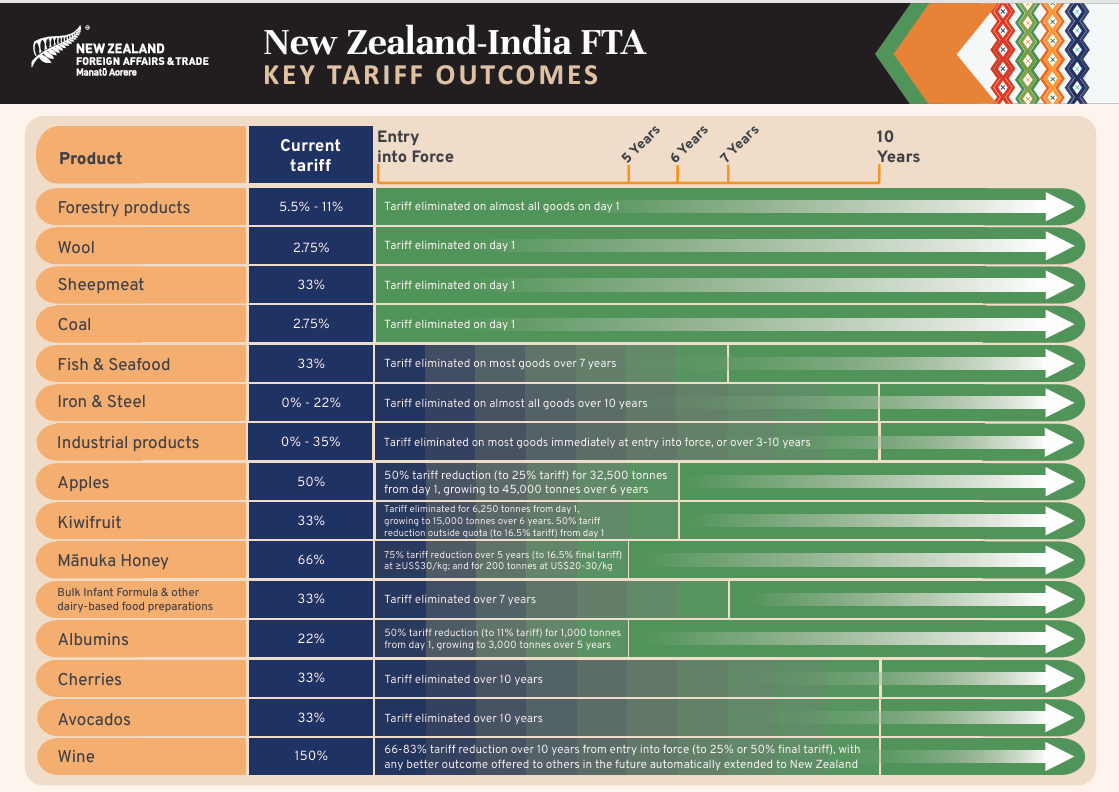
Key Tariff Outcomes under the India–New Zealand FTA
| Product Category | Pre‑FTA Tariff | Post‑FTA Outcome |
|---|---|---|
| Forestry products | 5.5% – 11% | Eliminated immediately |
| Wool | 5.5% | Eliminated immediately |
| Sheepmeat | 5.5% | Eliminated immediately |
| Coal | 2.75% | Eliminated immediately |
| Apples | 10% | Phased out over 6 years |
| Kiwifruit | 5.5% | Phased out over 6 years |
| Seafood | 33% | Phased out over ~7 years |
| Wine | 150% | Phased reductions over ~10 years |
| Manuka Honey | 33% | Reduced 75% over 5 years |
| Bulk Infant Formula & Dairy Preparations | 33% | Reduced gradually; duty-free in 7 years |
| Industrial/inputs | Up to 35% | Mostly eliminated/reduced |
Note: Consumer dairy products such as fluid milk, yoghurt, cream, cheese and similar items were explicitly excluded from duty concessions under the FTA to protect domestic production.
India's Dairy Sector Stays Off the FTA Table
India has reiterated that no duty concessions are being offered to New Zealand on its dairy imports — a stance highlighted by multiple reports, including from The Hindu, which confirmed that dairy remained a red‑line issue throughout negotiations. This means that existing tariffs on imported milk and milk products remain in force, protecting the livelihoods of millions of smallholder dairy farmers across the country.
This approach aligns with India's broader trade policy: Indian negotiators have historically maintained high tariffs on dairy products in FTAs to avoid market disruption, given that domestic milk production meets nearly all local demand and imports are relatively modest in volume.
Infant Formula and Ingredients: Strategic Access Amid Protection
India's Infant Formula Market Value
The Indiana infant formula and baby milk market is a high‑growth, value‑dense segment, valued at approximately USD 5.99 billion in 2024 and projected to expand further to around USD 9.27 billion by 2033 as incomes rise, urbanisation spreads, and consumer awareness of infant nutrition increases.
Even though India produces the largest volume of milk globally, certain specialised dairy ingredients and formula components — such as lactose, specialised whey derivatives and fortified nutrient bases — are sourced from imports to meet regulatory standards and product formulation requirements. India's dairy import landscape shows that whey and cheese are among the most imported dairy derivatives, owing to their use in further processing and food manufacturing.
What Does 'Duty-free Access for Bulk Infant Formula and High-Value Dairy Preparations Over Seven Years' Mean?
This means that:
- India will gradually reduce import tariffs on large-volume, industrial shipments of infant formula and specialised dairy preparations from New Zealand.
- These products will not receive immediate duty-free access; instead, tariffs will be phased out over seven years.
- By the end of the seven years, imports in these categories will be fully exempt from customs duties.
Why This Access Matters
- Support for Domestic Manufacturers: Indian food and nutrition companies can import high-quality formula ingredients at lower costs, improving competitiveness and expanding domestic production.
- Filling Specialised Gaps: Ingredients like lactose, whey protein, and fortified milk powder — not widely available in India — are essential for nutritional and infant care products.
- Consumer Benefits: Lower ingredient costs can reduce the final prices of infant formula, improve product quality, and help meet growing nutritional needs in India.
Balancing Protection and Growth
The FTA's careful construction reflects India's dual goals of:
- Protecting domestic dairy farmers and processors, whose economic security hinges on tariff‑based protections.
- Supporting emerging market opportunities in value‑added dairy segments such as infant formula and specialised nutritional products, where access to global inputs fuels innovation.
By strategically excluding core dairy products from tariff liberalisation, India has upheld its political commitments to rural livelihoods and food security. At the same time, phased tariff treatment for dairy inputs recognises the strategic importance of integrated dairy supply chains and the role of infant nutrition as a growth driver.
Conclusion: A Pragmatic FTA with Calculated Openings
The India–New Zealand Free Trade Agreement is a finely calibrated trade pact that seeks to boost bilateral economic engagement without undermining core domestic interests. India's decision to exclude dairy products from duty concessions while enabling preferential access for formula ingredients and other value‑added inputs illustrates its nuanced approach to trade liberalisation — protecting its extensive dairy sector while nurturing growth in higher‑value, downstream food production.
As implementation unfolds, Indian manufacturers and policymakers will need to maximise the benefits of access to high-quality dairy inputs under the FTA while continuing to support robust domestic supply and rural economic resilience.