India’s dairy sector has emerged protected yet strategically positioned under the newly signed India–Oman Comprehensive Economic Partnership Agreement (CEPA), concluded on December 18 in Muscat. While India has explicitly excluded dairy from any import duty concessions, the agreement allows Indian dairy exports to Oman to remain entirely permissible, creating a measured but potentially significant opportunity for export-oriented dairy players.
The agreement reflects India’s evolving trade posture. Politically and socially sensitive farm sectors are being shielded at home, while selective export access is being enabled in overseas markets where India sees long-term strategic value.
Dairy Imports Excluded to Protect Farmers and MSMEs
Under the CEPA, India has placed dairy products, including milk, butter, ghee, cheese and other milk derivatives, in the exclusion category, offering no tariff concessions to Oman. The Ministry of Commerce has classified dairy alongside other sensitive sectors such as tea, coffee, rubber, tobacco, precious metals and labour-intensive goods.
This decision is consistent with long-standing concerns across India’s dairy ecosystem. With more than 80 million rural households dependent on dairying, even limited exposure to imported dairy products, often supported by subsidies in exporting countries, could distort domestic prices and weaken farm incomes.
From a policy perspective, the exclusion reinforces a clear red line India has maintained across trade negotiations, including agreements with the UK and earlier discussions under RCEP. Dairy imports remain non-negotiable.
Export Side Open: What the CEPA Enables for Indian Dairy
Significantly, the CEPA does not restrict Indian dairy exports to Oman. On the contrary, Oman has committed to zero-duty access on more than 98% of its tariff lines, covering nearly all Indian exports by value.
For dairy, this translates into tariff-free or preferential access for Indian products entering Oman, subject to local food safety, labelling, and halal compliance requirements. While this does not automatically guarantee higher volumes, it removes a key structural barrier for Indian exporters.
Oman remains structurally dependent on food imports, with limited domestic dairy production capacity and climatic constraints on large-scale expansion. Dairy consumption is supported by urbanisation, tourism and a sizeable expatriate population, including a large Indian community.
From an export standpoint, the most commercially viable Indian dairy categories include milk powders for reconstitution and food service, ghee and butter oil, where India enjoys scale advantages, UHT milk suited to long supply chains, paneer and ethnic dairy driven by South Asian consumption, and fortified or lactose-free dairy targeting premium retail segments.
India’s strength lies less in fresh liquid milk and more in shelf-stable, value-dense dairy formats where logistics and storage risks are manageable.
What the Export Data Reveals
An examination of India’s agri-food exports to Oman in 2025 provides important context for the opportunity.
| Commodity | January | February | March | April | May | June | July | August | September |
| POULTRY PRODUCTS | 29215.866 | 33938.01 | 31574.69 | 27942.33 | 30662.37 | 46202.932 | 31672.63 | 35899.05 | 28487.62 |
| PROCESSED MEAT | 0 | 0 | 0 | 0 | 0 | 0 | 0 | 0 | 0 |
| SHEEP/GOAT MEAT | 13.56 | 12.147 | 18.158 | 12.939 | 15.428 | 11.656 | 15.786 | 11.44 | 15.097 |
| DAIRY PRODUCTS | 424.668 | 390.157 | 532.139 | 255.471 | 261.059 | 28.259 | 157.24 | 181.501 | 83.328 |
| BUFFALO MEAT | 1308.147 | 1645.301 | 2161.32 | 1282.643 | 1528.186 | 2006.077 | 1186.541 | 2152.784 | 1546.034 |
Quantities in Tons
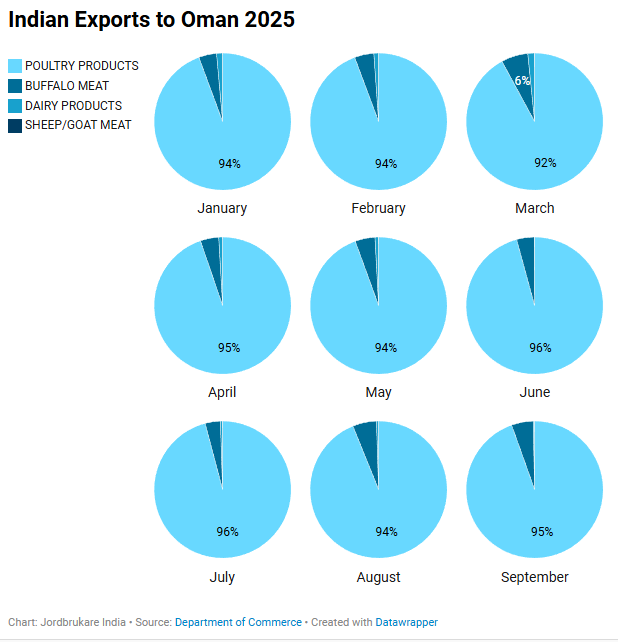
Between January and September 2025, Indian exports to Oman were dominated by poultry products, accounting for approximately 92-96 per cent of monthly shipments. Poultry exports ranged from around 28,500 tonnes to over 46,000 tonnes per month, peaking in June.
Buffalo meat emerged as the second most significant category, with monthly exports fluctuating between roughly 1,180 tonnes and more than 2,150 tonnes. While materially smaller than poultry, buffalo meat remains a structurally important export line, reflecting Oman’s reliance on imported animal protein and India’s competitiveness in halal-compliant meat supply chains.
In contrast, dairy products occupied a marginal position. Monthly dairy exports during the January to September period ranged from just 28 tonnes to around 532 tonnes, with a noticeable decline after March. In most months, dairy accounted for less than 1% of India’s total agri-food exports to Oman, as reflected in the accompanying charts.
Sheep and goat meat exports were negligible by comparison, while processed meat exports were absent altogether during the period.
Why Dairy Lags Despite Strong Import Dependence
The data does not point to a lack of dairy demand in Oman. Instead, it highlights structural and commercial constraints on the Indian side.
Historically, Indian dairy exports to the Gulf have concentrated on markets such as the UAE and Saudi Arabia, where distribution networks, brand familiarity and institutional buyers are more established. Oman has remained a secondary market.
Dairy exports also require deeper regulatory alignment, stronger quality assurance systems and either cold-chain or robust ambient logistics. These requirements are more complex than those for meat exports, which largely move through established institutional and food-service channels.
As a result, Indian dairy exports have traditionally prioritised South Asia, Africa and parts of Southeast Asia, treating the Gulf as opportunistic rather than strategic.
Why CEPA Matters Despite Small Dairy Volumes
It is precisely because dairy exports are currently small that the CEPA becomes strategically relevant.
Zero-duty access provides tariff certainty and improves price competitiveness for Indian dairy exporters in a market that is sensitive to landed costs. Even modest duty reductions can materially affect distributor margins in shelf-stable categories such as milk powder, ghee and UHT milk.
The data also shows that India already has a foothold in the Omani market, however limited. The CEPA offers policy stability that could encourage exporters to invest in partnerships, branding and compliance infrastructure.
Notably, the dominance of poultry and buffalo meat exports indicates that India is already a trusted supplier of animal-origin foods to Oman. Dairy exports can potentially build on this trust, provided quality consistency and regulatory compliance are strengthened.
Analyst Perspective
Commenting on the agreement, Prashant Tripathi, dairy market analyst and founder of Dairy Dimension, said:
“India–Oman CEPA is not a volume-led dairy export breakthrough, but it is strategically sound. India has protected its farmers by closing the door to imports while opening a controlled export corridor for value-added dairy products. For cooperatives and private processors with export discipline, Oman can serve as a credible Gulf entry point rather than a destination market in itself.”
Broader Trade Implications for Indian Dairy
- The agreement reinforces three structural signals for the dairy sector.
- Import protection remains firm, supporting domestic price stability.
- Exports will be encouraged selectively rather than indiscriminately.
- Future trade negotiations with the EU, the UK, and the GCC are likely to follow a similar template, with no concessions on dairy imports and cautious openness to exports.
For Indian dairy companies, the message is clear. Export growth will be driven by capability, compliance and consistency, not by tariff concessions alone.
Conclusion
The India–Oman CEPA may not transform India into a major dairy exporter overnight, but it preserves export optionality without compromising domestic interests. At a time of volatile farm economics and heightened sensitivity around food inflation, this balance is significant.
For Indian dairy, Oman represents an opportunity with clear boundaries. It is modest in scale, meaningful in strategic signal, and best suited to players who understand that global dairy trade rewards reliability and credibility more than sheer volume.