Introduction
India’s dairy sector plays a pivotal role in the rural economy, providing livelihood to over 8 crore farmers and contributing around 5% of the national GDP. India remains the world’s largest milk producer with 239.3 million tonnes of milk output in 2023-24, up 63.5% from 2014-15. Livestock (mainly dairy) has emerged as the growth engine of agriculture – the Economic Survey 2025-26 noted livestock GVA grew ~7.1% annually over the last decade (vs ~3.5% for crops), now contributing nearly 16% of farm income. This report examines the Union Budget 2026-27 through the lens of the dairy sector, comparing its provisions with those of the past five budgets (2021–2025) and integrating insights from the Economic Survey 2026 on livestock and rural development. We focus on central government initiatives – including budgetary allocations, schemes, subsidies, infrastructure investments, veterinary services, and credit/insurance support – and illustrate key trends with tables and charts for clarity.
Budget Allocations for Animal Husbandry & Dairying
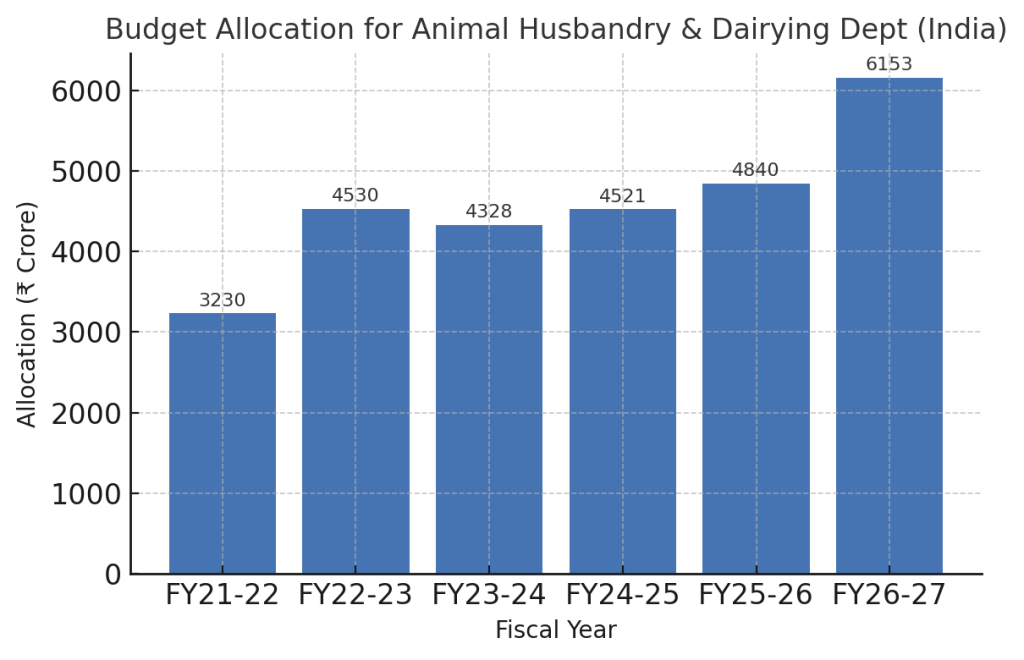
The Ministry of Fisheries, Animal Husbandry and Dairying has been allocated ₹8,915.26 crore (approx. USD 1,074.1 million) in 2026-27. A large share of this goes to the Department of Animal Husbandry & Dairying (DAHD), which receives approximately ₹6,153.46 crore (USD 741.4 million). This is a substantial jump of about 27% from the previous year’s allocation of ₹4,840.40 crore (approx. USD 583.2 million), marking the highest-ever annual budget for the department. The increased funding signals the government’s commitment to boost the dairy sector through targeted investments in schemes and infrastructure.
-
Comparison: In Budget 2025-26, DAHD was allocated ₹4,840.40 crore, representing about 0.15% of total expenditure. The current allocation of ₹6,153.5 crore significantly elevates the dairy sector’s profile in the national budget, keeping pace with its rapid growth (the livestock sector has been growing ~7% annually in recent years).
Union Budget 2026-27: Dairy-Related Provisions
Much of the DAHD budget is dedicated to key schemes under the government’s “White Revolution” initiatives. The 2026-27 allocations for major programs in the dairy and animal husbandry sector are as follows:
-
Livestock Health and Disease Control (LHDC): Allocated ₹2,010 crore (approx. USD 242.2 million) for 2026-27. This slight increase from ₹1,980 crore in the previous year bolsters nationwide vaccination drives (e.g. Foot-and-Mouth Disease control) and veterinary health services, which are critical for sustaining dairy productivity.
-
National Programme for Dairy Development (NPDD): Allocated ₹1,055 crore (approx. USD 127.1 million) under “Dairy Development” in 2026-27. This is up from ₹1,000 crore in the last budget, thereby boosting dairy processing infrastructure, milk chilling facilities, cooperative development, and other initiatives to increase milk production and quality.
-
Rashtriya Gokul Mission (RGM): Receives a major push with ₹800 crore (approx. USD 96.4 million) allocated in 2026-27. Notably, RGM, which focuses on indigenous cattle breed improvement and genetic enhancement, had only a token provision last year (₹0.01 crore) until a mid-year revision increased it to ₹700 crore. The new ₹800 crore allocation follows the Union Cabinet’s approval of an expanded RGM, with an outlay totalling ₹3,400 crore for 2021-26. This funding will be used to establish more “Gokul Grams” (cattle centres), conserve native breeds, and improve milk yield and herd productivity.
-
Animal Husbandry Infrastructure Development Fund (AHIDF): Allocated ₹465 crore (approx. USD 56.0 million) in 2026-27. The AHIDF is a flagship ₹15,000 crore (approx. USD 1,807 million) fund launched to spur private investment in dairy and livestock infrastructure (milk processing plants, cold chains, value addition, etc.). The budget allocation of ₹465 crore represents the government’s support this year in the form of interest subvention and credit guarantees that make AHIDF loans attractive to cooperatives and entrepreneurs. (Last year, ₹460 crore was provided for this fund.) This continued funding will help modernise milk processing and reduce post-harvest losses in the dairy supply chain.
-
New Entrepreneurship Development Scheme: A new initiative has been introduced with ₹500 crore (approx. USD 60.2 million) earmarked for an “Integrated Scheme for Entrepreneurship Development” in animal husbandry. As announced in Budget 2026, this scheme will provide credit-linked subsidies and support to livestock Farmer Producer Organisations (FPOs), startups, and individual entrepreneurs in the dairy and animal husbandry sector. The goal is to create high-quality rural employment and foster innovation in cattle rearing, dairy processing, feed production, and veterinary services. For example, the Finance Minister highlighted a plan for loan-linked capital subsidies to establish private veterinary colleges, rural veterinary hospitals, diagnostic laboratories, and breeding centres. By lowering the capital costs through subsidies, the government aims to encourage much-needed private investment in veterinary infrastructure and dairy enterprises in peri-urban and rural areas.
Together, the above schemes account for the bulk of the DAHD budget, reflecting a comprehensive approach: improving animal health, expanding dairy infrastructure, enhancing breeds, and promoting entrepreneurship. The total central sector scheme outlay for animal husbandry and dairying in 2026-27 is ₹4,830.00 crore (approximately USD 582.5 million), up from ₹4,042.25 crore in 2025-26, indicating a significant increase in government spending for the sector.
Trends from Past Five Union Budgets (2021–2025)
The past five Union Budgets (FY 2021-22 through 2025-26) exhibit a clear pattern of increasing support for animal husbandry and dairying, though with varying emphases each year. Table 1 summarises the DAHD budget allocations and key dairy-related measures for each budget, followed by further discussion of trends and outcomes.
Table 1: Budget Allocations and Key Provisions for Dairy Sector (Union Budgets 2021–2025)
| Budget (FY) | DAHD Allocation (₹ Cr) | Key Dairy-Related Measures (Central Initiatives) |
|---|---|---|
| 2021-22 | ~3,230 (est.) | The agri credit target is set at ₹16.5 lakh crore, with a focus on animal husbandry, dairy & fisheries credit. Continued funding for ongoing schemes (NPDD, RGM, etc.), but no major new dairy-specific scheme. |
| 2022-23 | ~4,530 (est.) | 40% jump in livestock budget allocation reflecting increased priority. Funding for the Rashtriya Gokul Mission & National Programme for Dairy Development was increased by ~20% to boost the productivity of indigenous breeds and dairy development. Livestock Health (One Health) allocation up 60% (for Foot-and-Mouth Disease and brucellosis control). Tax reforms (reduced AMT and surcharge) for cooperative societies were introduced, benefiting thousands of dairy cooperatives and ~8 crore dairy farmers by increasing incomes. |
| 2023-24 | 4,328 (BE) | The credit target has been enhanced to ₹20 lakh crore for the agriculture and allied sectors, thereby ensuring greater credit flow to dairy farmers. DAHD budget saw ~40% increase to ₹4327.8 Cr (vs previous year’s actual spending), marking a significant scale-up. Emphasis on cooperative development: plan to form multipurpose primary co-ops (including dairy co-ops) in every village over 5 years, and creation of a national cooperative database. The Gobardhan Scheme was expanded with a ₹10,000 crore investment to install 500 biogas plants that convert cattle dung into energy, thereby providing waste-to-wealth income for dairy farmers. New tax incentives: a 15% corporate tax rate for new cooperatives, and TDS exemption on cash withdrawals up to ₹3 Cr (raised from ₹1 Cr) for co-ops, directly aiding dairy cooperative societies’ operations. |
| 2024-25 | 4,521 (BE) | Allocation held steady (1% rise) at ₹4521 Cr, consolidating previous gains. Focus on the continuity of schemes and the completion of ongoing projects. A major policy development was the extension of AHIDF to 2025-26 with a revised outlay of ₹29,610 Cr, to further incentivise private investment in dairy infrastructure. This included a continued 3% interest subvention and credit guarantee support under AHIDF. The government also rolled out the Digital Agriculture Mission (2024), setting the stage for digital livestock services such as traceability and tele-veterinary care (as mentioned in the Economic Survey). No new scheme was announced exclusively for dairy in the Budget 2024, as it largely maintained funding levels and carried forward the flagship programs (PM-Kisan, livestock missions, etc.) in an election-year budget. |
| 2025-26 | 4,840 (BE) | DAHD allocation increased to ₹4,840.4 Cr (+7% YoY). Significant credit support: KCC loan limit for animal husbandry doubled from ₹ 3 lakh to ₹5 lakh under interest subvention, expected to benefit ~7.7 crore livestock farmers. A new central scheme for women and marginalised dairy farmers was introduced – targeting 5 lakh women, SC/ST beneficiaries – to promote women-led dairying and inclusive growth. Nutrition linkage was highlighted by integrating fortified milk into the Poshan 2.0 and Anganwadi programs, thereby bolstering milk demand and improving child nutrition. The National Livestock Mission was scaled up (e.g., by subsidising livestock insurance premiums to only 15% of the farmer's share across India to expand coverage). Overall, Budget 2025-26 built on prior initiatives with a sharper focus on inclusion (gender and SC/ST) and access to finance, while continuing investment in animal health and breed improvement (e.g., funding for Indigenous Breed Improvement under RGM was increased to accelerate genetic gains). |
(Sources: Budget documents and PIB releases for respective years.)
Trend Analysis: As shown in Figure 1 and Table 1, the central budget for animal husbandry saw a dramatic rise in 2022-23, when the government increased the ministry’s allocation by 44% (with the DAHD’s share rising about 40%). This enabled the scale-up of core dairy schemes such as RGM and NPDD and an unprecedented push in animal disease control (One Health program). The 2023-24 budget sustained this higher level (₹4328 Cr) and aligned with a broader “co-operative revolution” – reflecting the creation of a Ministry of Cooperation and measures to strengthen dairy co-ops (tax breaks, new co-ops in every panchayat, etc.). In 2024-25, the budget was relatively status quo in its allocations, focusing on the implementation of existing schemes rather than new announcements (likely due to it being the last full budget before the general elections). However, the period saw important steps like the expansion of AHIDF and the launch of the Digital Livestock Stack (as part of Digital Agri Mission) to improve service delivery – these were mentioned in policy forums and the Economic Survey. The 2025-26 budget renewed momentum with targeted initiatives: raising credit limits (which directly helps dairy farmers invest in more cattle or equipment) and launching an inclusivity scheme for women/SC-ST dairy farmers. Notably, women are central to India’s dairy sector (constituting the majority of the workforce in animal care and milk collection), and the budget recognised this by earmarking support for women-led dairy units. The inclusion of milk in Poshan 2.0 also demonstrated the convergence of nutrition policy and support for the dairy sector.
Financially, the Department’s budget over 2021-2025 grew in fits and starts – peaking in FY23, dipping slightly in FY24 (as fund absorption caught up), then rising again. By FY25, the allocation was about 50% higher than in FY21. The pattern indicates that the government front-loaded investments in critical schemes (such as NADCP for disease eradication, AH infrastructure, etc.) around 2021-23, then focused on ensuring that those funds translate into on-the-ground outcomes, and later added specific measures for credit and inclusion by 2025.
From a policy priority perspective, several consistent themes emerge over 2021–2025:
-
Credit and Insurance: Each budget steadily increased the agricultural credit target and explicitly earmarked credit flows for animal husbandry and fisheries. The target rose from ₹16.5 trillion in 2021-22 to ₹20 trillion by 2023-24. This resulted in the extension of millions of KCCs to dairy farmers and fishermen, thereby enabling access to low-cost loans. Additionally, the livestock insurance scheme under the National Livestock Mission was revamped around 2022-23 to heavily subsidise premiums (85% subsidy), encouraging farmers to insure their high-value milch animals against disease or death. By 2025, more farmers will be covered by livestock insurance (though this was achieved via scheme guidelines rather than headline budget announcements). These financial tools address risk and capital needs in the dairy business.
-
Infrastructure Development: The creation of financing instruments such as the AHIDF (2020) and the Dairy Processing & Infrastructure Development Fund (DIDF) signalled a shift toward bolstering processing and value-add capacity. Budgets in this period often mentioned these funds. For instance, Budget 2022-23 highlighted the merger of AHIDF and DIDF under the Atma Nirbhar Bharat stimulus, and subsequent budgets reported progress (AHIDF projects included adding processing capacity). The government’s support for dairy infrastructure also extended to rural infrastructure broadly – e.g. the Rural Infrastructure Development Fund was increased in 2021 (from ₹30k Cr to ₹40k Cr), indirectly aiding dairy by financing rural roads, electrification, and storage that benefit milk supply chains. In 2023, the Gobardhan initiative (500 biogas plants, ₹10k Cr) introduced a new dimension of infrastructure, converting dairy waste into energy. This not only improves farm revenue but also environmental sustainability.
-
Animal Health & Breeding: Controlling livestock diseases and improving genetics have been prominent goals. The 2021-23 Budgets invested heavily in the National Animal Disease Control Programme (NADCP) for FMD and brucellosis (now subsumed under the Livestock Health Programme). The One Health Mission, funded in 2022-23 (₹2,000 Cr+), aims to support comprehensive disease surveillance and vaccination, recognising that healthier cattle yield more milk and produce safer dairy products. On breeding, the Rashtriya Gokul Mission has been the flagship – its funding was boosted in 2022-23 and again revised in 2025 (with an extra ₹1,000 Cr allocated for the 2021-26 period). As per the National Milk Day 2025 report, these efforts contributed to a 27% rise in bovine productivity (yield per animal) between 2014 and 2022, although productivity levels remain low by global standards. The Economic Survey 2026 indeed flagged stubbornly low milk yields in India and stressed shifting from “more animals” to “better productivity per animal” – exactly what RGM and allied breeding programs aim to do (through artificial insemination, IVF, sex-sorted semen, etc.). By 2025, India was conducting over 565 lakh artificial inseminations per year under these programs, a scale-up aided by budgetary support.
-
Cooperatives and Market Access: A clear thrust of budgets, particularly the 2023 (“Amrit Kaal”) budget, was to strengthen the cooperative framework. Measures like reducing the tax rate for new co-ops to 15%, raising TDS limits, and provisioning ₹900 Cr in 2023-24 for a national cooperative database & computerisation of primary milk societies (mentioned outside the budget speech) all help the dairy sector, where cooperatives (e.g. AMUL, NDDB network) handle a large share of procurement. The formation of the Ministry of Cooperation and schemes such as “Sahakar se Samriddhi” were leveraged to expand dairy cooperatives into underserved villages, thereby bringing more producers into the formal milk marketing system. The expected outcome is improved price realisation for small dairy farmers through collective bargaining and access to organised processing. The Economic Survey 2026 noted that cooperatives provide a “stabilising influence” in dairy by assuring procurement and transparent pricing, and recent budgets have reinforced this model. Conversely, there is careful monitoring of the growing private dairy sector; the Survey indicated the need for safeguards as private milk procurement expands. Thus, policy is balancing cooperative growth with private-sector participation (e.g., via AHIDF loans to private dairies).
-
Inclusive & Sustainable Growth: Over the past five years, we also observed the budget narratives gradually incorporating inclusivity (gender, SC/ST) and sustainability. By 2025, a concrete scheme for women dairy farmers was launched, acknowledging women’s crucial role and aiming to enhance their access to credit, training, and leadership in dairy enterprises. Sustainability is addressed through initiatives such as Gobardhan (biogas from dung) and the promotion of ethnoveterinary medicine and antimicrobial resistance efforts (highlighted in the 2025 discussions). The push for natural farming (10,000 bio-input centres announced in 2023) is also relevant, as it encourages organic feed and reduces input costs for dairy farmers. All these tie into making dairy farming more climate-resilient, cost-effective, and equitable.
In terms of outcomes up to 2025: India’s milk production continued to grow ~5–6% annually, crossing 239 million tonnes in 2023-24. Per-capita milk availability reached ~ 471 grams/day, reflecting improved supply. The Economic Survey 2026 highlighted that allied sectors (dairy, poultry, fisheries) were crucial to achieving 4.6% agri-GDP growth despite volatility in the crop sector. It also pointed out that livestock GVA nearly tripled from FY15 to FY24 (195% increase) at current prices – evidence that budgetary and policy support have paid off in expanding the livestock economy. However, challenges such as high input costs (feed/fodder prices) eroding farmers' margins were noted, as feed accounts for ~70% of milk production costs and fodder shortages persist (11–32% green fodder deficit). These issues underline why budgets began focusing on areas like fodder development (e.g. support to millet fodder, use of fallow lands for fodder – part of 2022-23 One Health package) and innovation (e.g. a project to develop climate-resilient forage varieties).
Overall, the trajectory from 2021 to 2025 was one of scaling up investment, followed by targeted refinements to ensure the growth is inclusive and sustainable. The government’s central interventions – credit facilitation, infrastructure funding, health and breeding programs, and cooperative empowerment – have collectively positioned the dairy sector as a key driver for doubling farmers’ incomes and rural employment.
Insights from Economic Survey 2025-26
The Economic Survey 2026 reinforces the critical role of the dairy and livestock sector in India’s agricultural landscape and provides context for the budgetary focus. Key insights from the Survey include:
-
Livestock Driving Agricultural Growth: The Survey highlighted that, in recent years, agricultural GDP growth (4–4.5%) has been driven primarily by livestock and fisheries rather thanefly by livestock and fisheries, not crops. During 2015-16 to 2024-25, livestock grew at 7.1% CAGR (at constant prices) while the crop sector grew only ~3.5%. Consequently, livestock’s share in agricultural GVA has risen (though within livestock GVA, milk’s share dipped slightly from ~67% to 66% as meat/egg grew faster). This structural shift underscores why government budgets have steadily increased allocations to animal husbandry – to capitalise on this high-growth sector for boosting farm incomes. In 2026, the Finance Minister noted that livestock now contributes ~16% of farmers’ incomes on average, reflecting its importance for smallholders and landless families.
-
Income Security and Inclusivity: Dairy provides a steady cash flow to farmers, buffering income volatility from crops. The Survey explicitly recognised that dairying has become the backbone of income security for millions of small & marginal farmers and especially for women in rural households. It was noted that, as crop agriculture faces climate and price risks, daily/weekly milk sales provide a reliable source of revenue. This insight is reflected in budget measures such as the KCC expansion and women-focused schemes, which aim to bolster this dependable income source. The Survey also pointed out regional disparities – some regions and farmer groups have less access to formal credit and insurance – which validates the government’s efforts to extend KCCs, insurance, and cooperative reach (e.g., dairy FPOs in aspirational districts).
-
Productivity and Feed Challenges: A paradox noted in the Survey is that, although India achieved record milk production (due to volume growth in animal numbers), productivity per animal remains low by global standards. Indian cows/buffaloes yield far less milk on average than those in developed dairy nations. The Survey warns that a volume-led growth model (simply increasing herd size) is unsustainable, and future gains must come from higher productivity – “not more animals, but better animals and systems”. It identified key constraints: low genetic potential, inadequate access to quality feed and fodder, rising heat stress due to climate change, and uneven veterinary outreach. This analysis strongly supports the budget’s focus areas, including continued funding for RGM for genetic improvement, new programs to train veterinarians and build veterinary infrastructure (to improve health coverage), and fodder initiatives. The Survey provided stark data on feed deficits: India faces an 11-32% gap in green fodder, 23% in dry fodder, and a high deficit in quality feed concentrate. These shortages increase feed costs, squeezing farmers' margins. Acknowledging this, recent budgets (and associated policies) have promoted fodder cultivation (e.g., through hydroponics and fodder entrepreneur schemes under NLM) and ration-balancing programs. The fodder issue remains a critical area that future budgets may need to address more substantially (possibly via a Fodder & Pasture Development scheme).
-
Profitability Pressures: Despite rising milk output, dairy farmers' profits have been under strain due to escalating input costs. The Survey noted that feed, fodder, labour, and energy costs have risen faster than milk procurement prices in many areas, resulting in a cost-price squeeze on farmers. This has quietly eroded real incomes even in years of higher milk production. Such findings justify government interventions such as subsidising feed mills through AHIDF, providing working capital credit at low interest, and periodically increasing support prices or export incentives to keep farmgate milk prices remunerative. In late 2022 and 2023, for example, India experienced steep inflation in fodder prices and slow growth in milk supply, prompting some states to increase procurement prices. The central budget doesn’t set milk prices, but its schemes (like encouraging production of high-yielding forage varieties and supporting bulk milk chilling facilities to reduce losses) help improve farm economics. The Survey’s emphasis on value addition – converting milk to cheese, paneer, powders, etc. – is also an income-enhancing strategy. This aligns with the budget’s credit-linked program to create integrated dairy value chains, which will help farmers move up the value chain and capture greater value from each litre of milk.
-
Climate and One-Health Perspective: The survey drew attention to climate-related challenges (e.g., heat waves reducing milk yield and the emergence of lumpy skin disease) and highlighted the government’s One Health approach to zoonotic disease prevention. The Budget 2022-23 and subsequent funding for NADCP and veterinary vaccine research (e.g., the mention of new vaccine production facilities under AHIDF) are directly responsive to this. The Survey also lauded the push for ethnoveterinary medicine and Ayurveda in livestock health to reduce antibiotic misuse – an initiative supported by the Livestock Health & Disease Control scheme, which now funds training in herbal treatment for common ailments. Such integration of traditional knowledge can lower treatment costs and improve milk quality (by avoiding antibiotic residues).
-
Milk and Nutrition: From a broader viewpoint, the Survey placed dairy firmly in the nutrition and food security discourse. India struggles with malnutrition on one hand and lifestyle diseases on the other; milk, being a complete protein food, is crucial in diets. The Survey notes that milk and milk products are accessible, high-quality protein sources and endorses value-added dairy (such as yoghurt, cheese, and whey) for both income and nutritional gains. This justifies programs like milk fortification in school diets and the promotion of value addition – both of which feature in recent policy (e.g. Vita R&D under NDDB, and dairy entrepreneurship schemes for making local cheese, indigenous products, etc.). It’s worth noting that India’s per capita milk consumption (~ litres per year) has been rising, and budgets through schemes such as Operation Flood’s successor programs, PM Poshan, and others aim to sustain this trend for nutritional benefits.
In essence, the Economic Survey 2026 validates the direction of budgetary support: it confirms that investing in the dairy sector yields high returns in growth and incomes, but also cautions that structural issues (productivity, feed, climate resilience) need continued policy attention. The Union Budget 2026 responded to many of these points – by boosting vet services, supporting fodder innovation (though more could be done), and facilitating value chain development – indicating a science- and survey-driven approach to policymaking in the dairy sector.
Conclusion
Over the last five years, India’s central budgets have increasingly recognised that “the road to doubling farmers’ income runs through the dairy barn.” The Union Budget 2026-27 exemplifies this recognition: it builds on prior efforts with a significant push for veterinary infrastructure, entrepreneurial ventures in dairying, and sustained funding for critical schemes. Compared with 2021, the government spends substantially more on livestock development (central outlay up by ~90% by 2026-27 from 2021-22) and has launched innovative financing and support mechanisms for the dairy sector. This has enabled major initiatives, including nationwide FMD vaccination drives, modernisation of milk processing, empowerment of dairy cooperatives, and easier access to credit/insurance for dairy farmers, among others.
The comparative analysis shows a trend of continuity with expansion: core schemes such as RGM, NPDD, NLM, and LHDC have been continuously funded and adjusted to enhance impact (e.g., by merging schemes for efficiency and by increasing allocations as needed). Meanwhile, new interventions were introduced to fill gaps: credit access (KCC reform), gender inclusion, and the fostering of private investment through AHIDF and the new entrepreneurship scheme. The central government’s role remains that of an enabler – providing funds, incentives, and policy frameworks – while actual implementation lies in collaboration with state governments, cooperatives, and private stakeholders.
The outcomes so far are encouraging: robust growth in milk output, rising rural incomes, and greater resilience among farming households due to diversified income sources from livestock. At the same time, challenges like low per-animal yield, fodder scarcity, and market volatility persist, as highlighted by the Economic Survey. These will require continued focus and, if necessary, further policy innovations (e.g., a dedicated Fodder & Pasture Mission or incentives for climate-resilient dairy farming practices) in future budgets. Additionally, as India’s dairy sector marches towards a projected 330+ million tonnes of milk production by 2030, issues of processing capacity and export competitiveness will come to the fore – suggesting that funds like AHIDF and schemes for value addition will remain vital.
In conclusion, the Union Budget 2026 and the preceding budgets collectively exhibit a coherent strategy: strengthen the foundations of the dairy sector (animals, infrastructure, institutions) and empower the farmers who drive it. This bodes well for the millions of small dairy producers who are now better supported through government schemes and for the nation’s ambitions of a prosperous, self-reliant rural economy. With consistent policy support and on-ground execution, India’s “White Revolution” is set to sustain its momentum, delivering both nutritional security to the population and economic prosperity to those who milk the nation’s growth.
Sources: Official Budget documents and speeches, Press Information Bureau releases, Economic Survey 2025-26, Department of Animal Husbandry & Dairying reports, among others, as cited throughout.